
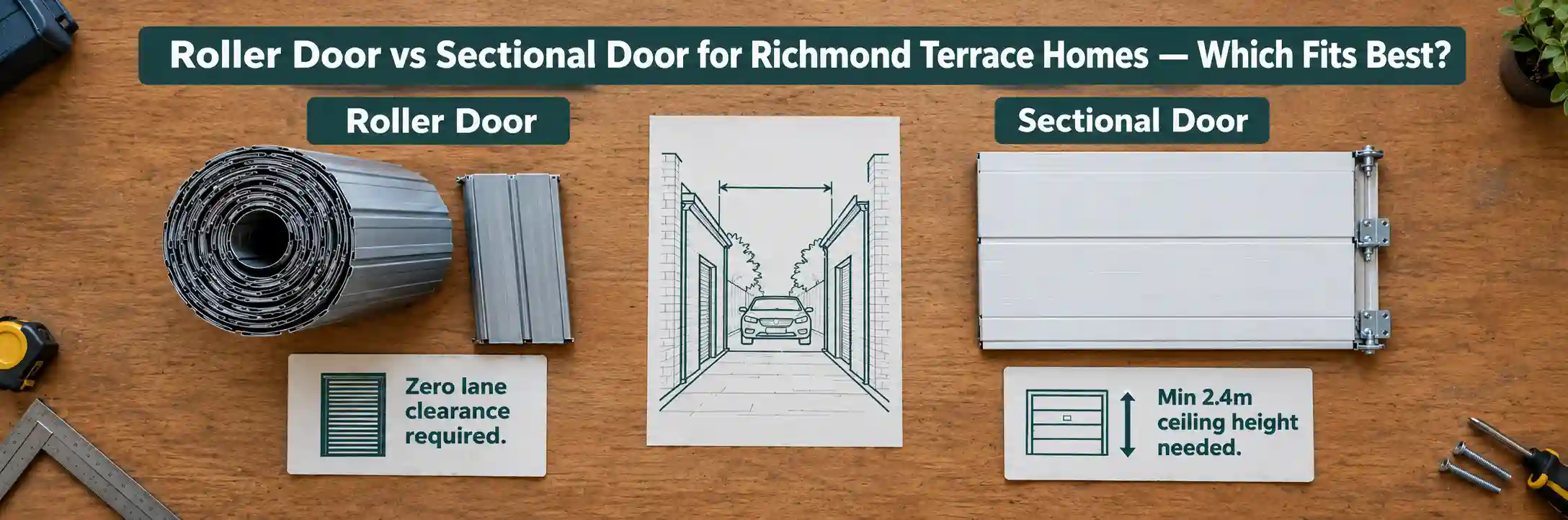
Choosing between a roller door and a sectional door for a Richmond terrace home is a more specific decision than it would be for a standard suburban property. Richmond’s inner-city terrace homes, back lane garages, heritage overlays, and compact garage dimensions create a set of constraints that make one door type clearly better suited than the other in the majority of cases. Roller door vs sectional door for Richmond involves the physical dimensions of the garage, the heritage planning status of the property, the access characteristics of the back lane, and the aesthetic requirements of an inner-city terrace home that sits within one of Melbourne’s most architecturally significant residential precincts.
How roller doors work and where they suit Richmond homes
A roller door consists of interlocking steel or aluminium slats that coil up into a drum above the door opening when the door is opened. The drum sits inside the garage ceiling or above the opening, and the door itself moves vertically without swinging out or tracking horizontally into the ceiling. For Richmond’s typical back lane garage, the roller door’s vertical travel is its primary advantage.
In a narrow back lane where the door opens directly onto the lane surface, a roller door that travels straight up requires no clearance space in front of the door opening. There is no swing arc that would require a pedestrian or cyclist to step back, and no horizontal tracking that needs to clear the ceiling of a low-slung garage. For the majority of Richmond back lane garages — which tend to be compact structures with modest ceiling heights built as part of lane-facing conversions — the roller door is simply the most practical choice.
Roller doors are also generally the lower-profile option visually, with a clean fascia that conceals the coiled drum and presents a flat, uncluttered face to the lane. For properties in a Heritage Overlay where the lane-facing elevation is assessed by the City of Yarra, a compact roller door profile is often easier to approve than a more architecturally prominent sectional door.
How sectional doors work and where they suit Richmond homes
A sectional garage door consists of horizontal panels hinged together that travel up and overhead as the door opens, guided by tracks that run from the door opening along the ceiling to the rear of the garage. The door panels end up stored horizontally above the garage floor space when the door is fully open.
For sectional doors to work correctly, the garage needs sufficient ceiling height to accommodate the track transition from vertical to horizontal — typically a minimum ceiling height of around 2.1 to 2.4 metres depending on the door height — and sufficient depth from the front of the garage to the rear wall to store the panels when open. For larger Richmond garages that have been purpose-built rather than converted from an outbuilding, these dimensions may be available and a sectional door becomes a viable option.
Sectional doors also project slightly in front of the door opening during the opening cycle as the bottom panel swings out before traveling upward. In a lane where another vehicle or a pedestrian might be passing during the opening cycle, this small forward projection is worth considering.
Heritage overlay — which door type is easier to approve
For Richmond properties within a City of Yarra Heritage Overlay, the choice between a roller door and a sectional door has a planning dimension. Heritage assessments focus on what the change looks like from the publicly accessible lane or street, and both door types can be appropriate depending on the specific circumstances.
In general, for lane-facing garage openings on heritage properties in Richmond, a quality steel roller door in a colour that complements the heritage property — typically matching or coordinating with the fence or gate colour — presents a modest, low-key appearance that is consistent with the functional lane-facing character that Richmond’s back lanes have historically had. The roller door’s flat profile and compact drum housing above the opening avoids introducing architectural elements that compete with the heritage character of the building.
A sectional door with panel profiles and raised detail can present a more prominent visual appearance that may attract more scrutiny in a heritage assessment. This does not mean sectional doors are inappropriate in Heritage Overlay areas — but they typically require a stronger argument for their heritage compatibility than an equivalent roller door.
Practical comparison for Richmond terrace home decisions
Roller door advantages for Richmond terrace homes:
- Vertical travel requires no lane clearance in front of the opening during operation
- Works well in compact garage spaces with lower ceiling heights
- Lower visual profile suitable for heritage lane-facing elevations
- Generally lower installation cost than a comparable sectional door
- Easier to insulate and seal against Melbourne’s weather in a rear lane setting
Sectional door advantages where Richmond garage dimensions allow:
● Panel-based construction allows for greater design variety including timber-look finishes
● Better insulation performance in double-skin or insulated panel versions
● Suited to street-facing garages on properties where a more architectural door appearance is appropriate
● Available in wider panel profile options that can suit a conversion garage where the opening is larger
What Richmond homeowners should confirm before choosing
Before deciding between a roller door and a sectional door for a Richmond property, confirm:
- The internal dimensions of the garage — ceiling height, depth, and opening width — and whether they support both door types or favour one
- Whether the property is in a City of Yarra Heritage Overlay, and if so what the council’s heritage guidelines say about the appropriate door type for the specific elevation and property
- Whether any existing permit conditions from previous garage works specify particular door types or materials
- The primary use case — is day-to-day lane access the priority, or is the door more occasional and the visual character from the street more important?
Automation options for Richmond roller and sectional doors
Both roller doors and sectional doors are compatible with automatic opener systems, and the choice of door type does not determine the automation options available. For Richmond’s inner-city terrace homes, automated opening via a remote control, smartphone app, or keypad is a significant quality-of-life improvement — particularly for residents who arrive home by car in Melbourne’s frequently wet weather and need to open the gate and the garage door before leaving the vehicle.
For roller doors, the most common automation systems use a tubular motor that sits inside the coil drum, making it invisible once the door is installed. For sectional doors, a drive rail motor similar to those used in standard residential automation systems is fitted above the door.
Both approaches are reliable and widely supported by Australian service technicians. When choosing an automated opener for a Richmond property, confirm that the opener is compatible with the specific door dimensions and weight, and that the remote control system is secure against interception — older fixed-code remote systems are vulnerable to signal capture.
Insulation and weatherproofing considerations for Richmond garage doors
For Richmond terrace homes where the garage is attached to or directly beneath the main dwelling, the thermal performance of the garage door has a direct impact on the comfort and energy efficiency of the home. Both roller doors and sectional doors are available in insulated versions, with foam-filled panels or double-skin construction that significantly reduces heat transfer through the door.
In Richmond’s back lane environment, the garage door also provides the primary seal against dust, noise, and draught from the lane. A well-fitted door with quality bottom seals and side seals reduces the lane noise that reaches the garage interior and, in properties where the garage connects to the home, reduces the noise transfer into the living spaces. For Richmond residents who work from home or who have a living area near the garage connection point, investing in a well-sealed and insulated garage door delivers benefits beyond temperature control.
Conclusion
Roller door vs sectional door for Richmond terrace homes comes down to the specific constraints of each property. For the majority of Richmond back lane garages — compact, lane-facing, and often in or near heritage overlays — a quality roller door is the most practical, heritage-compatible, and cost-effective choice. Sectional doors suit the minority of Richmond garages that have the internal dimensions to support horizontal tracking and the planning context where a more prominent door design is appropriate. Confirming the property’s heritage status and the garage dimensions before committing to either type avoids a situation where the chosen door cannot be approved or cannot physically fit the space.