
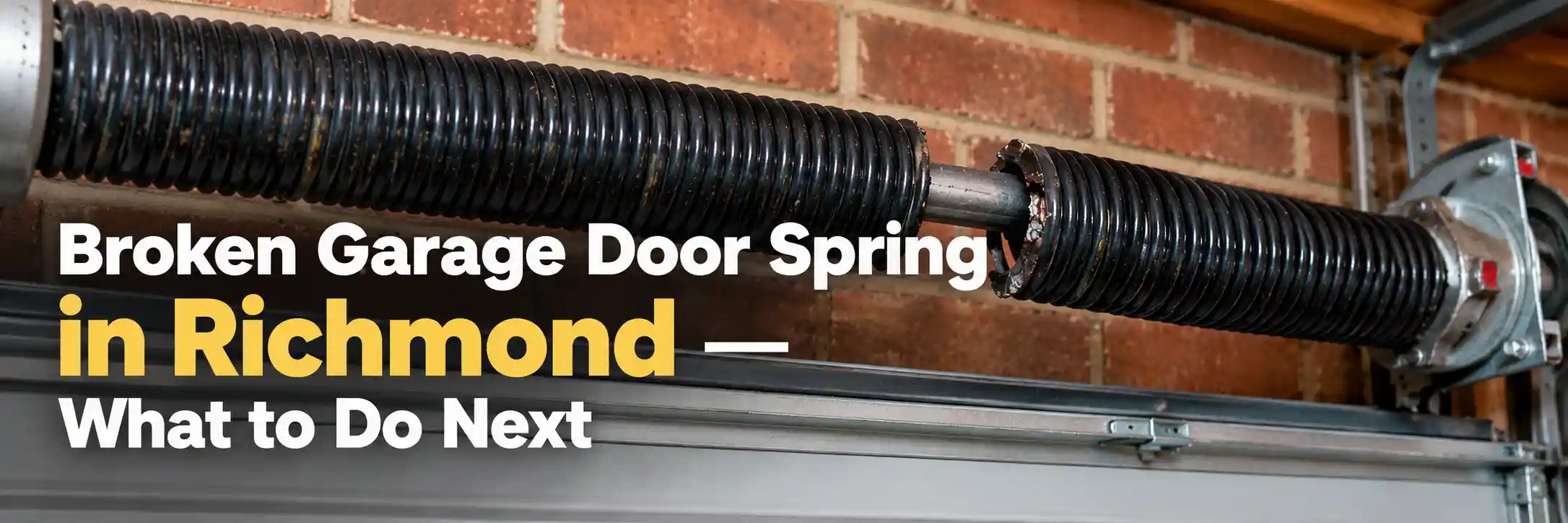
A broken garage door spring in Richmond is one of the most common garage door emergencies, and it typically happens without warning. One moment the door operates normally; the next it refuses to lift, feels impossibly heavy, or makes a loud bang as the spring snaps under tension. A broken garage door spring in Richmond leaves the door either stuck open — a security problem in a busy inner-city suburb — or stuck closed and inaccessible. Understanding what has happened, why it is not safe to operate the door yourself, and how to get it fixed promptly makes the difference between a manageable inconvenience and a prolonged disruption.
What a garage door spring actually does
The springs in a garage door system do the heavy lifting — literally. A standard garage door weighs between 40 and 80 kilograms depending on the material and size, and without the counterbalancing force of the springs, the electric motor or a person trying to lift the door manually would be working against that full weight. The springs store mechanical energy when the door closes and release it when the door opens, making the door effectively weightless to operate.
There are two main spring systems used in Australian garage doors. Torsion springs sit horizontally above the door on a metal shaft and twist to store energy. Extension springs run alongside the horizontal tracks on each side of the door and stretch when the door closes. Both types are under extreme tension even when the door is in the open position. When a spring fails, that stored tension releases instantly — hence the loud bang that often accompanies a spring failure.
Signs your Richmond garage door spring has broken
A broken garage door spring in Richmond produces several recognisable symptoms:
- The door will not open — the motor strains but the door barely moves, or the motor disconnects automatically to prevent damage. The door may lift a few centimetres and then stop.
- The door feels extremely heavy — if you disconnect the automatic opener and try to lift the door manually, it feels as though it weighs far more than normal. This is because it actually does — the spring is no longer counterbalancing the door’s weight.
- A visible gap in the spring — on a torsion spring system, you may be able to see a clear gap in the coil where the spring has separated.
- A loud bang from the garage — many homeowners describe hearing a bang from the garage as if something had been knocked over. This is the spring snapping under tension.
- The door hangs unevenly — on a two-spring system, if only one spring breaks the door may hang at an angle because the counterbalancing force is now uneven.
Why you should not operate a door with a broken spring
A broken garage door spring in Richmond should be treated as an immediate stop-use situation. Attempting to operate the door — manually or with the automatic opener — with a failed spring puts significant stress on other components of the system. The automatic opener is not designed to lift the full weight of the door without spring assistance, and running it in this condition can burn out the motor, strip the drive gear, or damage the drive rail. These are costly additional repairs that a simple stop-use decision prevents.
There is also a direct safety risk. A garage door without functioning springs can fall rapidly and with significant force if the remaining support fails. In a busy Richmond back lane where pedestrians, cyclists, and vehicles pass regularly, a falling door creates a serious hazard. Keep the door in its current position and do not attempt to force it until a qualified technician has assessed and replaced the spring.
Garage door spring replacement in Richmond — what the job involves
Replacing a broken garage door spring is not a safe DIY task. The springs operate under extreme tension and releasing or winding them incorrectly can cause serious injury. Australian standards and professional practice require spring replacement to be carried out by a qualified technician with the correct winding bars, safety equipment, and experience with the specific spring system fitted to the door.
A spring replacement in Richmond involves:
- Safely releasing any remaining tension in the failed spring and any intact spring on the system
- Removing the broken spring and measuring the replacement specification — diameter, length, and wind direction must match precisely
- Installing the new spring and winding it to the correct tension for the specific door weight
- Testing the door balance — a correctly tensioned spring should hold the door stationary at the halfway open position
- Testing the automatic opener if fitted, and adjusting the force settings if needed
- Lubrication of all moving components
Same spring or upgrade — what Richmond homeowners should consider
A broken garage door spring in Richmond is an opportunity to consider whether the replacement should simply match the original specification or whether an upgrade is appropriate. If the failed spring is the original from when the door was installed, it has reached the end of its rated cycle life. Replacing with an identical specification means the new spring will have a similar service life. An upgrade to a higher cycle-rated spring — available for most door types — extends the interval before the next replacement and may represent better long-term value in a high-use situation.
If the door has two springs and only one has broken, most experienced technicians recommend replacing both simultaneously. The second spring has the same number of cycles on it as the failed one and is statistically likely to fail soon. Replacing both in one visit avoids a second call-out and the disruption of a second failure.
Spring life expectancy and Richmond’s usage patterns
Garage door springs are rated by the number of cycles they are designed to complete before failure. A cycle is one complete open-and-close operation. Standard residential springs are typically rated at 10,000 cycles, while higher-specification springs are available at 20,000 or 30,000 cycles. For a Richmond household that uses the garage door twice a day, a 10,000-cycle spring has a theoretical life of approximately 14 years. For a property where the garage is used more frequently — as a regular vehicle storage point in a suburb where off-street parking is at a premium — the spring will reach its cycle limit sooner.
Richmond’s inner-city environment also subjects springs to moisture and temperature variation that can affect the metal over time. Springs in lane-facing garages that are exposed to Melbourne’s weather and the temperature swings that come with it may show wear at a rate that is faster than the cycle count alone suggests. Inspecting springs annually for rust, corrosion, or visible deformation gives early warning of a spring that is approaching failure.
The cost of delaying a broken spring replacement in Richmond
A broken garage door spring in Richmond that is left unaddressed creates a cascade of potential problems that make delayed repair more expensive than immediate action. Running the automatic opener against the full weight of an unsprung door — even briefly — can damage the motor windings, strip the drive gear, or bend the drive rail. These are components that cost significantly more to replace than a pair of springs.
If the door is stuck in the open position and the property is left unsecured while waiting for a repair, the cost of that delay extends beyond mechanical damage to include the security implications of an open garage in a Richmond back lane. Richmond’s inner-city location means back lanes are used by more people than a quiet suburban street, and an open, unattended garage represents a genuine security exposure. Prompt repair is the straightforward solution to both the mechanical and security dimensions of the broken spring situation.
Conclusion
A broken garage door spring in Richmond stops the door and should stop any attempt to operate it. The job requires a qualified technician with the correct tools and experience — same-day service is typically available in inner Melbourne suburbs including Richmond, Cremorne, and the broader City of Yarra area. Replacing both springs simultaneously and considering a higher cycle-rated spring are the two decisions that reduce the likelihood of a repeat failure in the near future.